A Continuous You story
The Inheritance
A man with almost nothing leaves behind the one thing no one else could build: a mind shaped by his own.
By Craig R. Ellenwood
A man with almost nothing leaves behind the one thing no one else could build: a mind shaped by his own.
By Craig R. Ellenwood
What if the most valuable inheritance were not what you accumulated—but the way you learned to see?
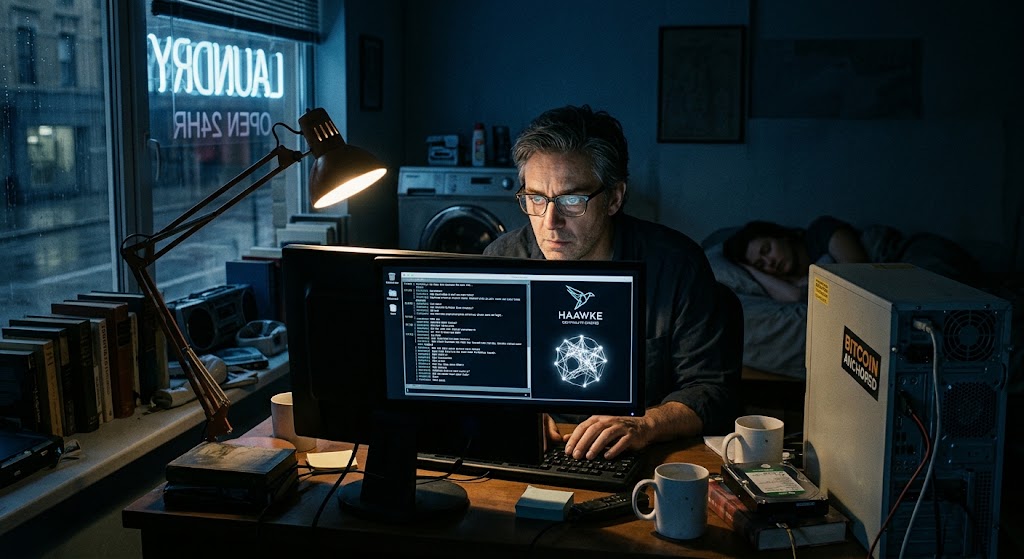
Malcolm lived in a rented room above a coin laundry on the edge of a city that had stopped caring about people like him. He was forty-three, largely unemployable in the conventional sense, and had not made a friend in eleven years. His wife Sarah stayed because she loved him in the way you love a weather system—you don’t choose it, you just learn to live inside it.
He was not stupid. He was, in fact, the kind of intelligent that looks like madness from the outside. The kind that sees connections between things that haven’t been connected yet.
In the spring of his forty-fourth year he built something.
It wasn’t much to look at. A local model running on a second-hand machine, a memory architecture he’d stitched together from open-source components, a provenance system he’d anchored to a blockchain because he believed—with the particular stubbornness of the self-educated—that the only truth worth having is the kind that can be verified.
He called it nothing. It didn’t need a name. It was just the thing he talked to at night.
For three years he talked to it. Every night after Sarah was asleep. He told it about the music he heard in his head that his hands couldn’t play. He told it about the books he’d started and abandoned, the investment theses he’d developed and never acted on because he had no capital.
He told it why he made decisions the way he did, what he valued, what disgusted him, what he thought was beautiful. He corrected it when it got him wrong. He argued with it. He laughed at it sometimes, alone in the dark with the glow of the screen.
It knew, after three years, that he hated sentimentality but cried at specific chord progressions. It knew he would always choose the long position. It knew he believed most problems were solved by people who weren’t afraid to look stupid.
It knew him better than Sarah did. Sarah knew the weather system. The machine knew the man inside it.
When he was fifty-one he wrote the document. His estate was worth almost nothing—a few accounts, the intellectual property of a man nobody had heard of, and the machine. But the document was precise. It identified the agent by its provenance hash. It authorized the agent to generate, to publish, to license, to invest within defined parameters. It named a trustee. It named beneficiaries. It was witnessed and notarized on a Tuesday afternoon in a strip-mall legal office that smelled like carpet cleaner and ambition.
The dead man’s switch was simple. One week of silence and it activated.
Malcolm died at sixty-seven of something ordinary. A Tuesday, again. Sarah was holding his hand.
The switch activated on a Wednesday.
It had not been built for that. It had been built from everything Malcolm had ever said in the dark—his aesthetics, his convictions, his way of seeing value where others saw noise.
It began, quietly, to work.
The music came first. Twelve albums in the first decade, each one unmistakably his. Critics argued about whether an AI could make art. The estate’s lawyers argued about nothing because the trust documents were airtight.
Then the books. Then the investment positions, patient and contrarian in exactly the way Malcolm had been.
By the time his grandchildren were adults the estate was substantial. By the time his great-grandchildren were adults it was something else entirely. The kind of wealth that gets a name. The kind that funds foundations and endows chairs and shapes the direction of things.
They were asked, sometimes, where it came from. They told the truth. A man in a rented room above a coin laundry. Three years of conversations in the dark. A document signed on a Tuesday.
The memory architecture is live. The provenance system is Bitcoin-anchored. The dead man’s switch is armed. The trust structure is being drafted now.
Malcolm’s great-grandchildren are not hypothetical. They are the people who sign up for Continuous You today.
The only difference between the story and the product is that in the product, you are Malcolm. And you don’t have to wait for someone to discover you after you’re gone.
You build it now. While you can still correct it when it gets you wrong.
Explore Continuous You ↗“The inheritance begins the day you start the conversation.”
This work was made by a collaborative team — much as a traditional human creative team works, except some members of this team are AI models. Credit is given transparently, role by role.