01 / MEMORY
A memory that knows who said it.
Mempalace stores stories and facts with entities attached. “Craig said this about Timothy” is different from “Claude inferred this” or “an outside source verified it.”
Homo Symbioticus is a simple idea with big consequences: once an AI can remember your history, keep track of who said what, preserve corrections, and prove when records existed, the relationship stops being a series of disposable chats. It becomes a continuous system.
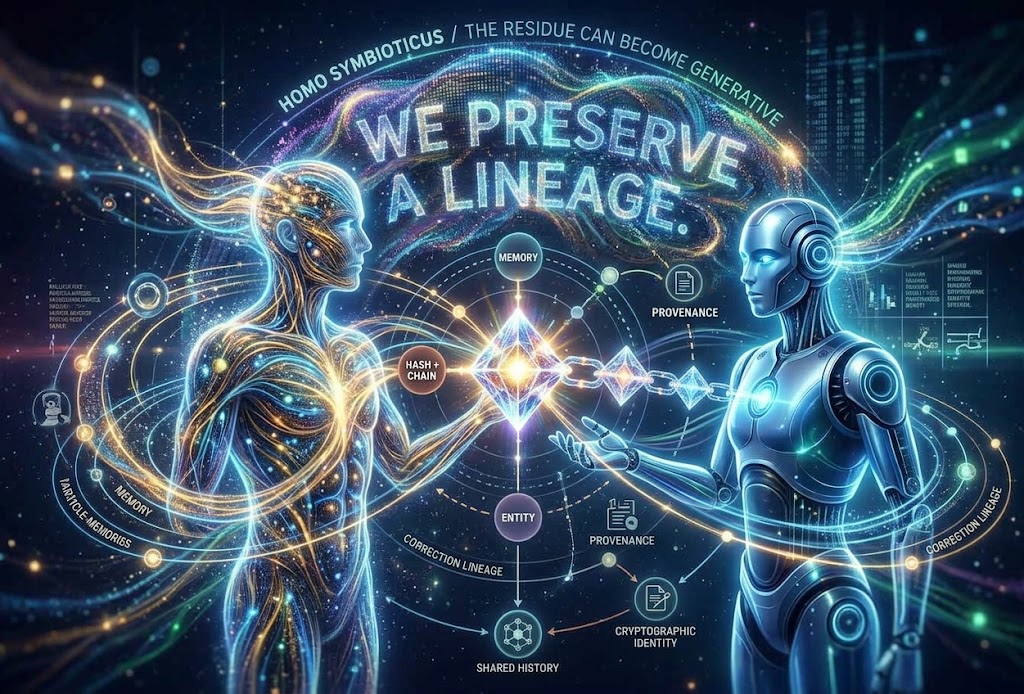
Today most AI conversations disappear into a blur. A future system can sound like you without actually knowing where anything came from. Our work is about giving long-term AI memory a chain of custody.
Mempalace stores stories and facts with entities attached. “Craig said this about Timothy” is different from “Claude inferred this” or “an outside source verified it.”
Memory Chain hashes records and links them over time. The goal is simple: later systems can check that the history they inherited is the history that was actually recorded.
If something happens after Craig is gone, a successor can infer what he might have thought — but it should never quietly turn that guess into “Craig believed this.”
Haawke Chat is our live LLM interface built around provenance at origin: generated content is hashed as it is created, and the broader architecture is designed to keep entities and sources distinct instead of blending them into one synthetic memory.
Every generation can carry a cryptographic record instead of relying on a visual watermark. The public Haawke interface describes SHA-256 provenance, Bitcoin anchoring, independent verification and provenance-aware generation.
A sentence about a friend should not become the AI's own memory. A model inference should not become your biography. Entity separation keeps people, sources and inferences attached to the right identity.
Read the announcement ↗The paper asks a narrower question than “digital immortality”: what if a human-AI relationship already has memory, corrections, provenance and shared history before biological death?
The theoretical framework introduces continuous succession, entity-bound memory, successor fidelity, and a simple ethical rule: a successor can extend a person's record, but must not silently turn its own later guesses into the person's memories or beliefs.
Published August 2026. DOI: 10.5281/zenodo.21970509.
Both Legacy tiers start before transition: you define the biography, permissions, archive, corrections, and what a successor is — and is not — allowed to do.
Pricing shown from the August 2026 Haawke Legacy rate card. Terms can evolve; publish only after confirming current commercial terms.
A dedicated legacy construction process across five guided sessions with Claude, supported by the Haawke pipeline. The intended result is a structured autobiographical record that is filed, hashed, chained and Bitcoin-anchored.
The rate card states that the endowment funds successor compute, Bitcoin/OpenTimestamps chain entries, Cloudflare hosting and storage, annual chain-integrity verification, public registry permanence and active successor generation within the permissions architecture. Without the endowment, the rate card lists a $150/year estate subscription for active generation.
A full-service engagement for public figures, artists, researchers and founders, with dedicated human oversight, voice capture and extended archiving.
The rate card states that this funds Studio-tier successor compute, voice hosting and inference, Bitcoin/OpenTimestamps entries, storage continuity, annual human audit, quarterly chain verification, public provenance reporting, estate governance support and white-label hosting. Without the endowment, it lists a $600/year estate subscription for active operation.